
Jev: the new AI model that answers with probabilities, not words
ByGilad Dor Levi
TypeSafe AI just launched Jev, a System 1 model built by an OpenAI RLHF co-creator that returns calibrated probabilities instead of text, in under 500 milliseconds.
A new kind of AI model caught my attention this month, and it doesn't write a single word. It answers with probabilities instead, and that turns out to unlock a class of software that a normal chat model was never built for.
Meet Jev, the model that skips language entirely
TypeSafe AI released Jev on September 15, calling it the first "System 1 model." The name is a deliberate nod to Daniel Kahneman's split between fast, intuitive judgment and slow, deliberate reasoning. A regular large language model works like System 2: it reasons step by step, token by token, and that's exactly what makes it slow. Jev is built to behave like System 1 instead: give it a state and a set of typed questions, and it returns calibrated probabilities in roughly 70 to 500 milliseconds, no sentence involved.
The company behind it isn't a random startup chasing a trend. Jev comes from Diogo Almeida, a co-creator of RLHF at OpenAI who co-authored the InstructGPT paper and worked on GPT-4's post-training, alongside a $40 million seed round led by DCVC. That's part of why the release got covered by TechCrunch rather than staying a niche curiosity.
A few concrete numbers, for anyone who wants the specifics up front. Typical latency runs 70 to 500 milliseconds per decision. TypeSafe prices input at $0.042 per million tokens, with output free since there's no generated text to charge for. Vercel reported 5 to 18 times faster results after swapping an OpenAI model for Jev on command-safety checks. Bryo AI found it 10 to 20 times cheaper than Gemini for email classification.
What "returns probabilities instead of text" actually means
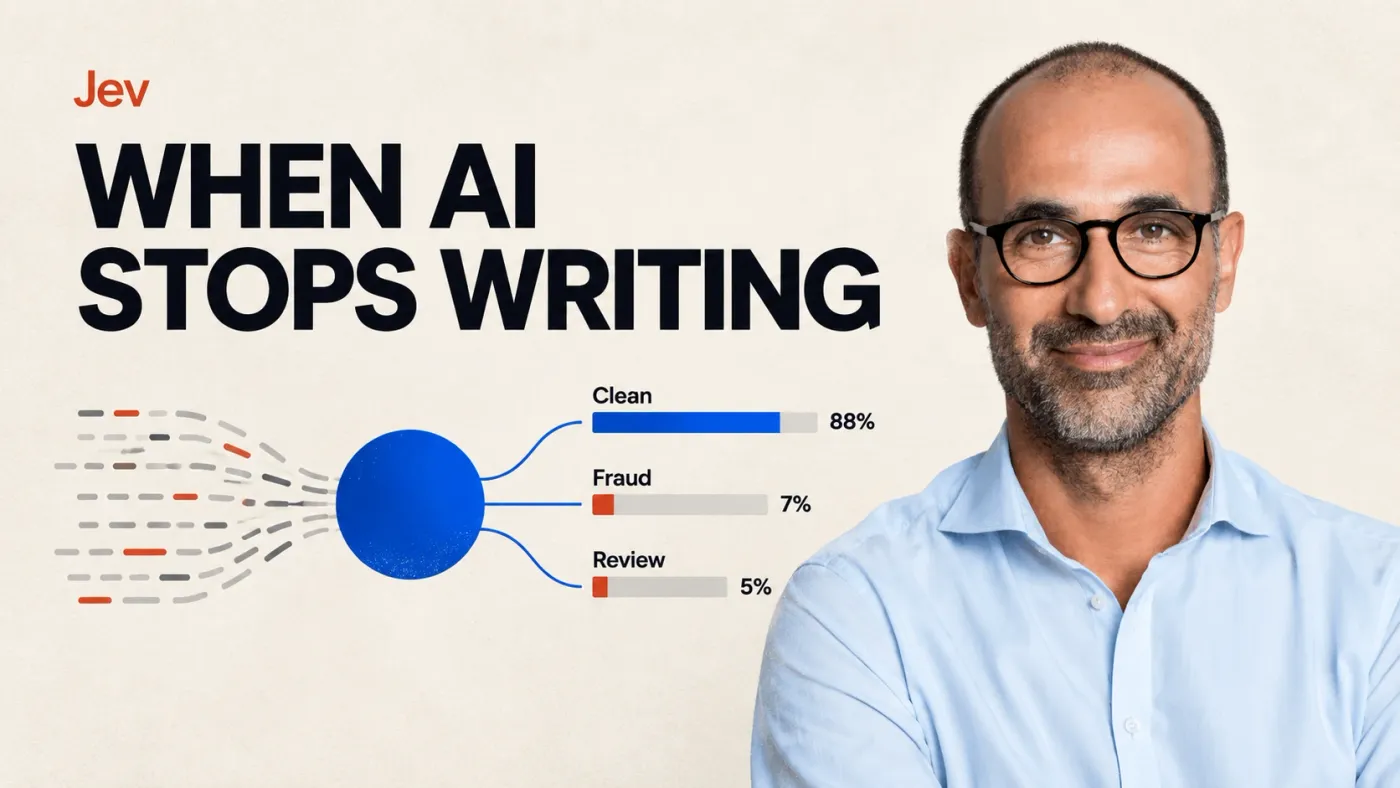
A chat model asked whether an invoice looks fraudulent will write a paragraph explaining its reasoning, one token after another. Jev gets the same kind of question and instead returns something like: 88 percent clean, 7 percent fraud, 5 percent needs review, scored all at once rather than generated in sequence. You define the categories you want scored, Jev scores every one of them in a single pass, and nothing gets typed out.
That single design choice explains most of what makes it interesting to me. Sequential generation is the reason a chat response takes seconds, since token five can't start until token four exists. Scoring every option in parallel removes that bottleneck entirely, which is also why a single Jev call can answer several unrelated questions about the same input, a support ticket's routing, urgency, and refund likelihood, in one pass instead of three separate model calls.
TypeSafe trained it with what they call Reinforcement Learning for Calibrated Decisions, aimed specifically at getting the confidence scores right rather than just getting an answer that sounds confident. A model that always insists it's found the answer isn't actually more useful than one that says "80 percent, and here's why I'm not sure about the rest."
Where it's actually being used
The vendor's own benchmark numbers are worth treating as exactly that, vendor numbers, and some of the figures circulating in early coverage go well past what TypeSafe itself claims. The Vercel and Bryo AI results above are narrower and more believable, and they're the ones that actually convinced me the category is real: routing, scoring, and classification tasks that don't need a written explanation, just a fast, reliable decision.
The use cases that show up repeatedly are the ones where a chat model's latency was always the real obstacle, not its intelligence. A game character deciding whether to attack or retreat needs an answer in under 150 milliseconds, not a paragraph of reasoning. A self-driving simulation reacting to a red light can't wait multiple seconds per decision. A form that scores how qualified an applicant is has to update as someone types, not after a delay long enough to break the interaction. None of that is really about writing better sentences faster. It's about removing sentences from the loop entirely.
What it's clearly not for
Jev can't write code, hold a conversation, or explain its reasoning the way a chat model does, and that's by design rather than a current limitation. It scores, classifies, ranks, and routes. It doesn't reason step by step or generate anything longer than a label and a number. Comparing it to a frontier chat model misses the point a little, since the two are solving different problems: one produces language, the other produces a decision a program can act on directly.
Why this matters beyond the demo videos
The practical case for a model like this shows up wherever a business already has a decision buried inside a slow or expensive process: a support queue that needs routing before a human ever reads the ticket, a lead form that should flag high-intent visitors while they're still typing, a content moderation step that currently waits on a much heavier model just to output a single label. None of that needs a system that writes prose. It needs a system that decides, cheaply enough to run on every request instead of a sampled few. That's a narrower, less flashy problem than "build a chatbot," and it's exactly the kind of gap that existing software quietly pays for today through delay, sampling, or a human doing the triage by hand.
The part worth remembering
The interesting shift here isn't really about speed or price, even though both are real. It's that "AI model" stopped meaning one thing. For the last few years, the assumption was that intelligence in software meant a chat interface, or at least a model that talks. Jev is a reminder that plenty of software doesn't need language at all. It needs a fast, cheap, well-calibrated decision, and building that as a separate category from conversational AI, rather than trying to make a chat model faster, is what actually made the difference.
Keep reading

ArticleAI
OpenClaw + Jev: Stop Burning 26,000 Tokens on "Thank You"
A single "thank you" can cost OpenClaw around 26,000 tokens. Here's how I put TypeSafe AI's Jev in front of it, a model that returns a decision instead of text, and cut that to about 400.

ArticleAI
Kimmy K3: When an Open‑Source Model Upends the AI Balance of Power
A new open‑source model is closing in on frontier performance — and rewriting the cost math for every business building on AI. Here's what it means for you.

GuideAI
AI marketing skills: a practical guide for Claude, ChatGPT and Codex
My guide to the Marketing Skills library: choose skills, install them in Claude and OpenAI environments, and build a marketing workflow with 9 prompts and factual checks.
Follow us
TikTok · X · Instagram · Telegram
Ready to automate?
Let’s build a system that works for you — not the other way around.