
Armin Ronacher on Minimal Agents, Trust, and the Interface Nobody's Solved Yet
ByGilad Dor Levi
Armin Ronacher, the creator of Flask and co-founder of Earendil, breaks down why minimal agent harnesses win, why full autonomy has a real ceiling, and why open source can only be judged in hindsight.
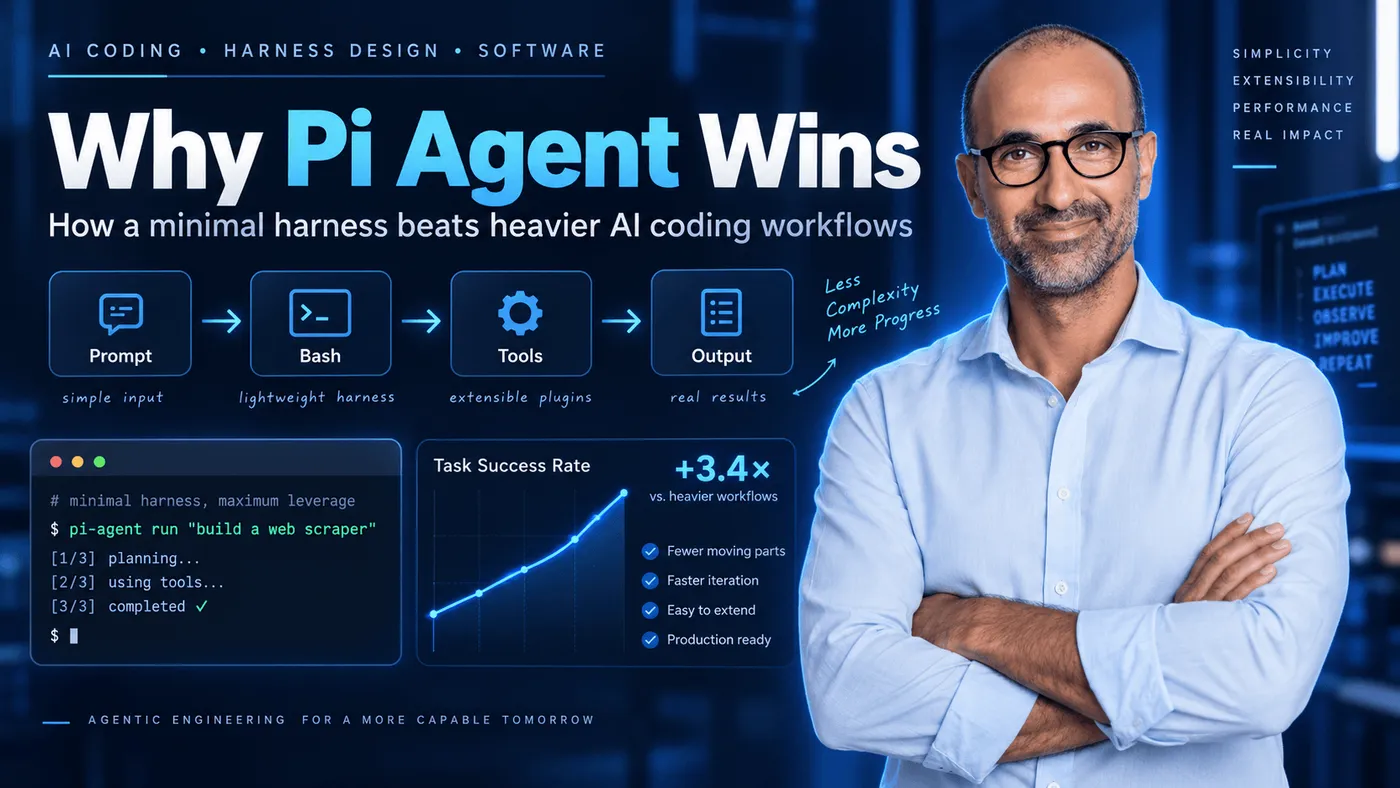
A recent podcast conversation with Armin Ronacher, the creator of Flask and co-founder of Earendil, the company behind the Pi coding agent, reframed a few things for me about how agent tools actually get built, and why the simplest option sometimes wins for reasons that have nothing to do with simplicity for its own sake.
Minimal isn't a style choice, it's a bet on where models are headed
Pi is one of the leanest agent harnesses out there, and by several benchmarks it's also one of the strongest. Ronacher's explanation is refreshingly unromantic: models have gotten genuinely good at operating a computer directly, so a harness that mostly hands them bash and gets out of the way plays to that strength instead of working against it. Even Codex, a much heavier harness on paper, quietly relies on the same trick under the hood, piping commands together and using tools like rg to search files rather than pulling everything into context.
The interesting part is why he bet on this early. Reinforcement learning training data was the tell: whatever's easy to train models on tends to be where the field ends up. Betting on that direction turned out to be the right call, though he's candid that the field has gotten crowded enough that the next year or two is genuinely less predictable than the last one was.
Why Pi actually caught on
Extensibility, not minimalism, was the hook. Pi shipped lean, but it was built to be made your own, at a moment when some competitors were racing in the opposite direction, stacking on tools until every update reshaped your whole workflow. That trend has already started reversing: newer versions of some major harnesses carry noticeably fewer built-in tools than they did at their peak, and at least one competitor has rebuilt itself entirely around a plugin model. Self-extensible software, it turns out, aged better than maximalist software.
There's a positioning point underneath this too. Earendil isn't trying to be "the Pi company" forever. The stated goal is closer to making AI genuinely useful for everyone, and the harness is just the starting point, not the destination.
The interface problem, and why it isn't an AI problem
Ask what's still unsolved, and the answer that stands out most is interface, not intelligence. Agents today are mostly stuck inside a chat transcript. Ask one to manage your smart-home setup, and it can follow instructions, but it can't hand you back a real, durable dashboard of your devices the way a proper app would. That gap gets treated as a taste or creativity problem sometimes. Ronacher's take is that it's neither: it's ordinary systems architecture, state management, component libraries, durable data storage, the unglamorous plumbing that has nothing to do with model capability and everything to do with nobody having built it well yet.
One shift tucked inside this deserves its own mention: certain technologies that were always technically better but too fiddly for most humans are becoming mainstream again because agents don't mind the fiddliness. Rust, NixOS, and complex database setups all fit that pattern. There's a sharper version of this too: agents are unusually good at Linux specifically because an enormous amount of how Linux works is documented and discussed publicly, which means it's heavily represented in training data. Mac support trails a bit behind for the same reason in reverse, and Windows, in his words, is basically outside the distribution entirely.
Why full autonomy has a real ceiling
One prediction stands out: banks are unlikely to ever let an agent "vibe code" their systems, no matter how capable models get. The reasoning has nothing to do with model quality and everything to do with accountability. When something breaks, someone has to be answerable for it, and a machine can't fill that role. That single constraint, not a technical limitation, sets a real ceiling on full autonomy in plenty of domains, and it isn't going away just because models improve.
A related, quieter prediction follows from that: humans are going to keep wanting to see roughly the same interface an agent sees, plain text, markdown, JSON, Unix pipelines, rather than some opaque internal representation. Plain formats aren't elegant; they're legible, and trust runs on legibility. If the only way to check an agent's work is to ask another agent whether it did the job right, that's not really oversight at all.
A surprisingly conservative day-to-day setup
For someone building a coding agent company, the workflow he described was more restrained than I expected: no fleet of dozens of autonomous agents running a "software factory," mostly a single fast local machine, a Linux box reached over SSH for things that need to stay running, and a bit of CI automation. Most of the daily work isn't even code generation. It's investigating a problem together with the agent before anything gets written.
One story from that conversation stuck with me. While debugging something with someone else's setup, it came out that their "cloud" coding agent environment had never actually run a real database test, not once. Postgres had never been properly wired up; the agent had just been mocking it out the entire time. Cloud dev environments will get there eventually, but the ephemeral-environment problem that trips people up (getting a fresh, fully working setup, database and all, spun up fast enough to be usable) is still unsolved in practice for a lot of real-world stacks. He recalled that onboarding new engineers at Sentry used to take two to three days just to get a working local environment, and it took a dedicated team to bring that down meaningfully. Cloud coding agents are running into a version of the same problem now, just one layer up.
Enterprise AI spend versus what people actually build
There's a real gap worth naming here between two groups: engineers building personal side projects on their own time, who seem to be getting genuine, visible value out of these tools, and large enterprises rolling out coding agents at scale, where the return is a lot murkier. More commits and more shipped code, sure. Clear revenue impact tied directly to that, much less so. One dry observation: some of that enterprise spend isn't even producing new value, it's a new permanent cost line, like the security scanning now required because models have also gotten very good at finding exploitable code, which means someone has to keep paying to check your own codebase before someone else does it for you first.
Judge open source only in hindsight
The idea I keep coming back to from the whole conversation is this one: whether an open-source project is any good can only really be judged in hindsight, by whether it's still around, still maintained, and still useful ten or fifteen years later. Early PHP, by his own account, was rough, embarrassing even by the standards of its own era, and widely mocked for it at the time. Judged only by year one, it would have looked like a bad bet. Judged today, with a mature ecosystem like Laravel built on top of it, it looks like a clearly good one. Curl and Django get the same treatment: neither one won by being the most novel technical idea on the market. They won because people kept showing up and maintaining them, year after year, long enough that reliability itself became the differentiator.
There's a practical edge to this as well: being well-represented in a model's training data is a real, openly discussed competitive advantage right now, since it makes a technology the default an agent reaches for. That's also why a lot of newer "open source" AI projects deserve a second look before you trust the label: plenty of them are open mainly for the free CI infrastructure and marketing halo, with no real commitment to sticking around, which is exactly the kind of project that tends to go closed-source later without much announcement once it's gotten what it needed.
The takeaway
None of this reduces to "smaller is better" or "just wait it out." It's closer to: know which problems are actually AI problems (not many, it turns out) versus which ones are ordinary systems and trust problems wearing an AI costume, and build for the second kind with the same patience good open-source maintainers already understand. That's a much less exciting story than the next model release, but it's probably the more honest one.
Keep reading

ArticleAI
Zero Trust for AI Agents: Lessons from a 100-Agent Assessment
An assessment of 100 AI agents found a risky capability combination in 98% of its sample. What that result means, what it does not prove and which controls to check before connecting an agent to business systems.

ArticleAI
Harness, Loop Engineering, and LLMOps: How AI Agents Are Actually Controlled
Agent harness, loop engineering, and LLMOps aren't just buzzwords — they're three simple ideas that turn a raw language model into a business AI system you can actually trust.
GuideAI
AI Video With Opus 5.5: The Prompt Is Only 10% of the Result
Try "one prompt, finished video" and you get a generic clip. The prompt is only 10% of the result: motion rules, a real brand, references, sound and a critique loop do the rest.
Follow us
TikTok · X · Instagram · Telegram
Ready to automate?
Let’s build a system that works for you — not the other way around.