
Harness, Loop Engineering, and LLMOps: How AI Agents Are Actually Controlled
ByGilad Dor Levi
Agent harness, loop engineering, and LLMOps aren't just buzzwords — they're three simple ideas that turn a raw language model into a business AI system you can actually trust.

"Agent harness," "loop engineering," "LLMOps" — these terms are everywhere right now, and they sound intimidating. They're not. Each one describes a fairly simple idea, and together they explain how a raw language model turns into a business-ready AI agent that can actually be trusted to do a job.
A powerful brain with no memory and no direction
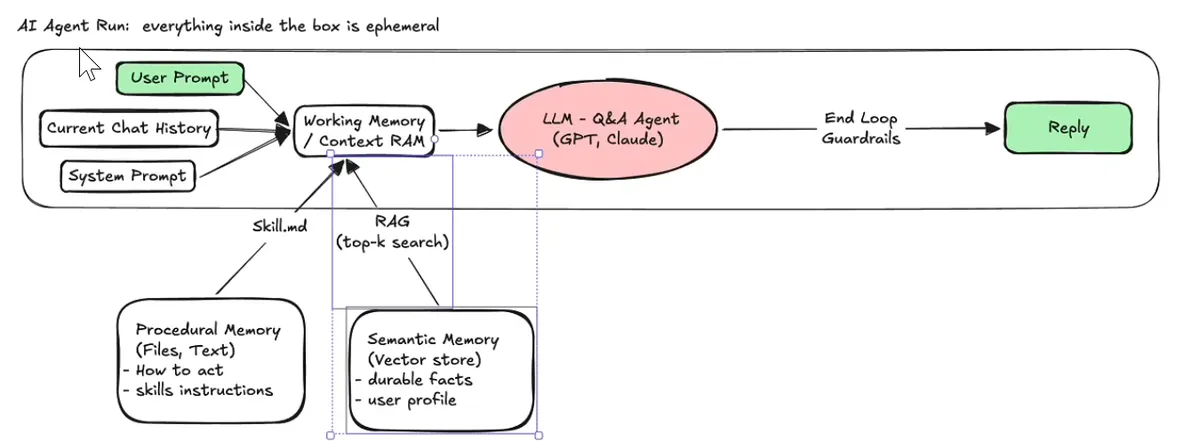
A large language model like GPT or Claude knows an enormous amount about the world — but it knows nothing about you, your business, or how you want it to behave. Every conversation starts from scratch: a question comes in, whatever chat history exists comes in, and a reply goes out. There's no persistent memory built in, only what happens to be inside that one exchange.
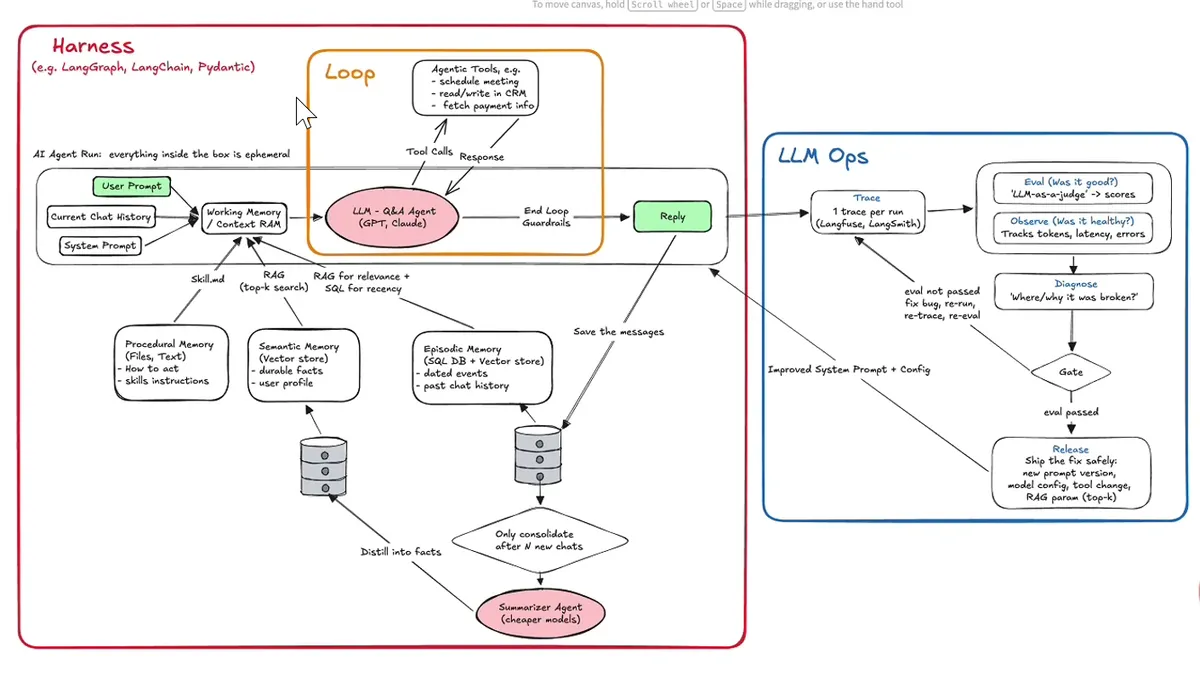
That's the exact gap a business-grade AI agent has to close. If you want an agent that knows how to talk to a specific customer, remembers past interactions, and follows your company's rules, you need something wrapped around the model that supplies all of that context. That wrapper is the harness.
The harness: turning a language model into a usable agent
The word harness comes from horseback riding — the set of gear that lets a rider control a powerful animal and point it in the right direction. The language model is the horse: enormous raw capability, but without control it will "wander," because under the hood it's just predicting the statistically most likely next word.
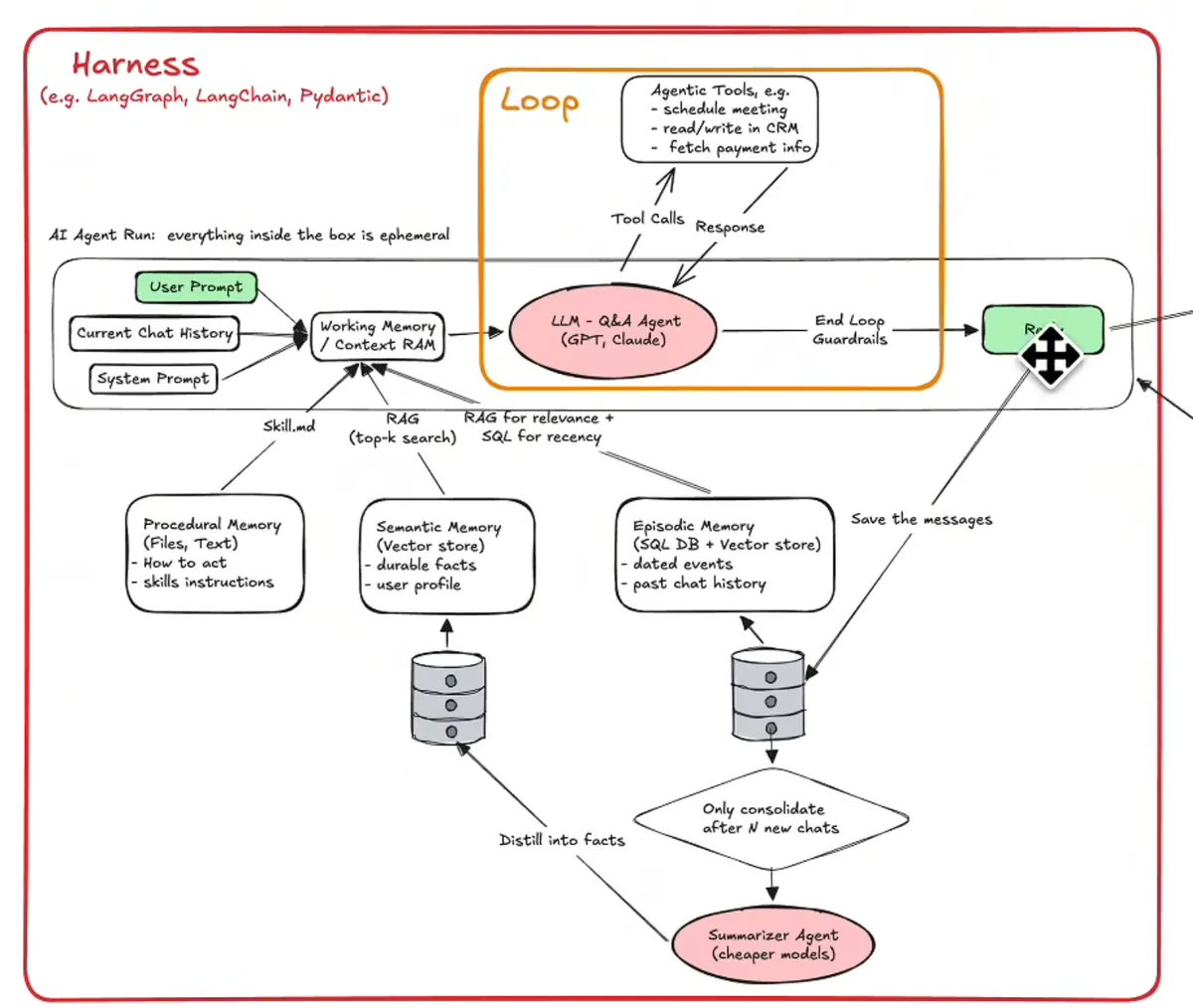
The harness is everything built around the model: a system prompt that defines its role, a memory layer that feeds it context, and tools it can call to actually do things — book a meeting, pull records from a CRM, trigger a refund through a payment processor. Frameworks like LangChain or LangGraph are examples of tooling that helps assemble a harness, but the underlying pattern matters more than any specific framework.
The memory layers that make an agent feel like it "knows" you
For a harness to work well, it needs access to a few distinct kinds of memory, each stored and refreshed differently:
- Procedural memory — instructions for how the agent should behave. Usually a plain text or markdown file (what people now call a "skill").
- Semantic memory (durable facts) — stable information about the customer, business, or context that doesn't change conversation to conversation.
- Episodic memory — a timestamped, chronological record of past interactions and events. None of these layers appear out of nowhere — they live in a database and get updated deliberately. When conversation volume is high (thousands of customer messages, for instance), storing everything raw stops making sense. Instead, after a batch of conversations, a separate summarizer agent distills the relevant facts into semantic memory, so future retrieval stays fast and cheap. Combining semantic search (RAG) with straightforward date filtering is what lets an agent pull exactly the relevant slice of history instead of drowning in it.
Loop engineering: knowing when to stop
Once an agent can both read memory and call tools, a task rarely finishes in a single pass. It might need several rounds: check a data source, draw a conclusion, call another tool, check again. That sequence is the loop, and managing it is what loop engineering actually means.
The main risk is an agent that doesn't know when to stop — either it keeps calling tools indefinitely, or it quits before the task is actually done. A well-designed loop has clear guardrails: a defined condition for "done," a clear point to pause and check with the user (should it actually issue the refund, or just report who's owed one?), and a way to alert someone if the agent is stuck waiting on a permission. There's no universal formula — the right stopping logic depends entirely on the task — but without an explicit stopping mechanism, an agent loop can't be trusted to run unsupervised.
LLMOps and eval: proving the agent actually works
Building an agent is one step. Knowing whether it's doing its job correctly is a separate discipline entirely — LLMOps (large language model operations). Every agent run, from the incoming question to the final reply, gets logged through a tracing system that records every memory lookup, every tool call, response times, and token usage.
That data feeds two layers of checking:
- Evaluation — did the agent actually accomplish what was asked? This can mean using a second language model as a judge to score the response, or running deterministic checks (did the meeting actually get created on the calendar?).
- Diagnosis — when something goes wrong, why? Maybe response time spiked because the agent pulled too much history into working memory, or a tool call failed silently. When the checks pass, teams ship small, targeted updates — a refined system prompt, a model configuration tweak, an adjustment to retrieval rules. When something is fundamentally broken, they go back, fix the underlying bug, and rerun the whole trace-evaluate-diagnose cycle. That loop is what turns an AI system from a one-time build into something that keeps getting better on its own.
The takeaway
Harness, loop engineering, and LLMOps aren't three separate technologies — they're three parts of the same system: how you give a language model context and memory (harness), how you control how many actions it takes before it stops (loop), and how you verify it's working correctly and keep improving it over time (LLMOps). For any business that wants an AI agent it can actually rely on — not just a chatbot that guesses — these three building blocks are the starting point, not technical details to skip past.
source https://github.com/ShenSeanChen/waku-agent
Continue the workflow
Before connecting an agent to data and tools, use the Zero Trust guide to AI agent security to plan permissions, secret isolation and human controls.
To connect tooling with daily work, read the agentic engineering stack guide: interfaces, subscriptions and skills and evaluate the choices against your tasks and constraints.
Keep reading

ArticleAI
Harness Engineering: The Next Phase After Prompt and Context Engineering
From prompt engineering, through context engineering, to harness engineering - the story of how AI system building actually evolved.

ArticleAI
Loop Engineering: Overhyped Buzzword or a Real Shift in How Coding Agents Work?
Everyone's talking about loop engineering, but almost no one agrees on what it means. Here's what's actually happening under the hood - and why the stop condition is the only part that really matters.

GuideAI
AI Video With Opus 5.5: The Prompt Is Only 10% of the Result
Try "one prompt, finished video" and you get a generic clip. The prompt is only 10% of the result: motion rules, a real brand, references, sound and a critique loop do the rest.
Follow us
TikTok · X · Instagram · Telegram
Ready to automate?
Let’s build a system that works for you — not the other way around.