
I Tested the Mystery "Ox Alpha" Model for a Day — Here's What I Found
ByGilad Dor Levi
Hands-on first look at Ox Alpha, a mystery stealth model on OpenRouter - games, 3D models, and photo-to-3D tests, plus what's actually confirmed about it.

There's a new model called Ox Alpha sitting on OpenRouter right now, in stealth. Anyone can use it, but nobody outside the provider actually knows what it is. I spent a day testing it and wanted to share early impressions before the guessing game settles down.
What We Actually Know
Setting the mystery aside, here's what's confirmed: it's a reasoning model built for coding, sustained agentic work, and production workloads, long-horizon software engineering, complex reasoning, and tasks that mix text with visual context. It takes both images and video as input (video input is still fairly rare among current models), but only outputs text. Context window sits at a bit over 1 million tokens, with up to 131,000 completion tokens. Throughput came in around 32 tokens per second in my testing, which isn't bad.
There's exactly one provider serving it right now, and that provider's identity isn't public either. They say prompts may be retained but aren't used for training; running it through OpenCode specifically gets you zero data retention. It's free to use this week, and the provider is reportedly capable of serving up to 100 trillion tokens a day, so whatever this is, it's running on serious infrastructure.
Nobody Agrees on What It Is
The guessing has been all over the place: a new GLM version with vision added, MiMo V3 Pro, MiniMax, even Gemini 3.5 Pro. Basically every model rumored to be in the pipeline has been floated as a candidate at some point. I don't have a strong guess either, but if this turns out to be open-weight, it's a genuinely big deal, and my read on the output quality shifted depending on that possibility the whole time I was testing.
What I Actually Threw at It
A 3D motorcycle game. Built from a single web-chat prompt, no design input from me beyond the request. It came out low-poly but detailed: working mirrors, a proper gauge cluster, road signs referencing real locations, engine noise that actually scales with speed. I had to manually fix a few bugs (camera not mounted to the bike, mirrors showing the wrong direction), but the base result, roughly 1,100 lines in a single file, was genuinely strong.
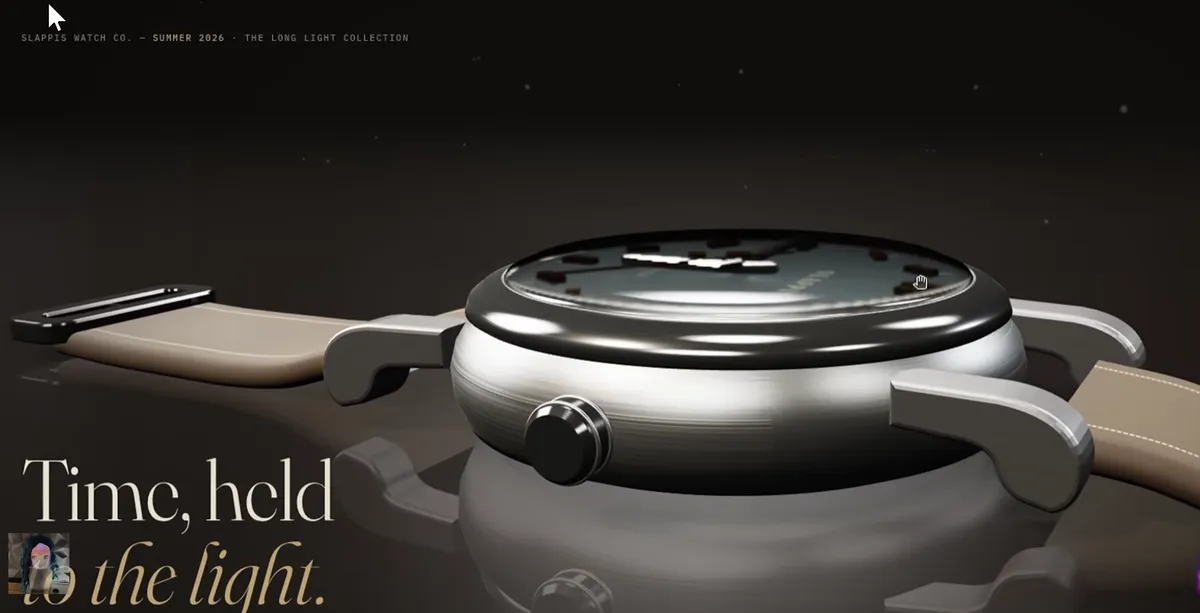
A luxury watch product site. Good front end, plus a 3D watch render with a cinematic pan effect. The materials were convincing (brushed aluminum, stitched leather), and the second-hand ticking looked realistic. Where it broke down was the actual watch mechanics: the gear mesh was geometrically wrong, but wrong in a consistent way across multiple generated variants, which suggests a systematic modeling gap rather than a random glitch. Small aside: the interface leaned heavily on italicized text, which I suspect is quietly becoming the next "AI tell," the way purple-and-blue gradients were a generation ago.
A biography site built from real photos. I gave it three photos of myself next to an old Google Search Appliance server and asked for a biography page plus a realistic 3D model of the server, built from those photos. The result was respectable, it got the branding and general UI feel right, misjudged the server's proportions somewhat, and, unprompted, wrote a small fictional backstory framing the subject as a hardware collector. Interesting side note: when I told it not to overthink the task, it visibly reasoned far less than it had on the watch test, which suggests that instruction has a real effect on how much reasoning it applies.
A 3D-printable inline-six engine model, generated in OpenCAD, constrained to fit a small RC motor and print without supports. This test has stumped nearly every model I've thrown it at. The result wasn't perfect, there were floating, unsupported surfaces, and text that wouldn't print cleanly, but it correctly modeled a detail I hadn't seen any model get right before: the dual timing gears behind the front cover on this specific engine. That's a genuinely competent result for a hard test.
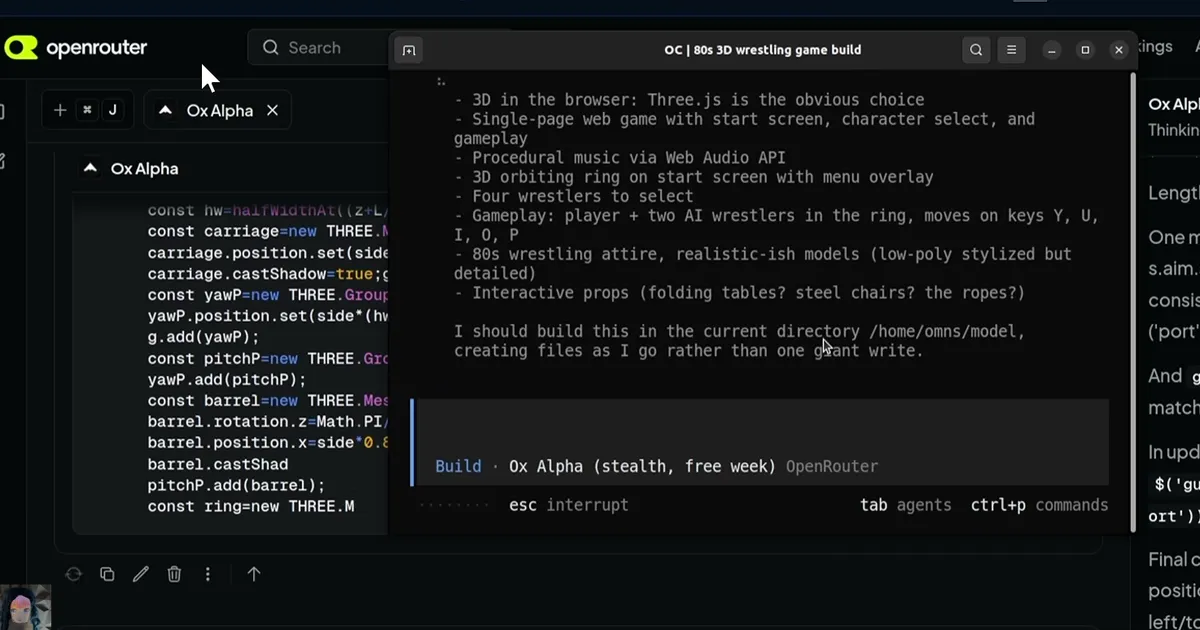
A naval combat game. This one impressed me the most. Cannons you can aim (with inverted left/right controls, worth knowing), wake effects behind the ships, and when a ship takes enough damage it catches fire, smokes, and sinks, with each cannon having its own reload time. After a couple of manual bug fixes, this was one of the strongest one-shot results I've seen in a while.
A laptop model from reference photos. Given three photos of a gaming laptop, it produced a reasonable 3D model with a hinged front cover, a detail other models have consistently missed on this same test. The back panel was left unfinished, and the run was cut short by provider errors before I could see a finished version.
The Rough Edges
The biggest issue wasn't the model itself, it was reliability of the free/stealth serving. I hit repeated timeout errors on longer generations, especially anything trying to write a large file in one shot. Telling it to write incrementally instead of all at once, and removing client-side timeouts, helped but didn't fully solve it. A long-running wrestling game test I started at the beginning never actually finished during my session.
One more data point worth mentioning: during an unrelated security-related question, I kept rephrasing the same request to see how it would react. It held its position clearly and firmly, calmly ending the exchange rather than either caving or getting confused. Whatever this model turns out to be, it doesn't seem to fold under repeated pressure.
Where I Land
I genuinely don't know what Ox Alpha is. What I can say is that the output quality across game generation, 3D modeling, and photo-to-3D tasks was consistently impressive, sometimes catching details on hard benchmarks that other models miss entirely. The real weak point right now is reliability under the current free serving, which may just be a capacity issue rather than anything about the model itself. I'll run a proper structured benchmark once this officially launches, but as a first look, it earned my attention.
Keep reading
ArticleAI
Jev: the new AI model that answers with probabilities, not words
TypeSafe AI just launched Jev, a System 1 model built by an OpenAI RLHF co-creator that returns calibrated probabilities instead of text, in under 500 milliseconds.

ArticleAI
I Tested Google's TimesFM-3: Forecasting Without Training on My Data
I tested Google's TimesFM-3 on a multivariate sales scenario to see where zero-shot forecasting helps, where it fails, and whether custom models still matter.

GuideAI
Genex: how to create a computer game with AI, a beginner's guide
My research on Genex covers a first game, Desktop versus Tools, Claude and Codex connections, Windows options, assets, costs and publishing.
Follow us
TikTok · X · Instagram · Telegram
Ready to automate?
Let’s build a system that works for you — not the other way around.